
Facing Facts Online and the anti-hate community of practice
by Joanna Perry, with Arletta Pérez Hernández
Introduction
We have been busy at Facing Facts Online, the online learning space for the Facing Facts Network. Since spring 2025, we have revamped our Understanding and Responding to Hate Speech course, created the brand-new Fair Policing and Hate Crime course, and run two cohorts of each. We also continue to focus on building knowledge and evidence to help us understand what best supports our community to learn best online. Later this year, we will be able to share some early findings from our evaluation that will bring new data on the impact of our courses on our learners’ knowledge, skills and professional development.
For those of you who have followed our work over the years, you will know that we are always looking for ways to improve connections across communities, countries and institutions to strengthen responses to hate. In this blog, we share how we use Community of Inquiry principles to design the small-scale, intensive and multi-actor learning that takes place in our cohorts. We then look at the (potential) relationship between these focused learning communities and the broader anti-hate community of practice, the wider ecosystem of professionals working on hate responses across Europe and beyond.
Hate response systems and victim and outcome-focused frameworks
We have shown that comprehensive legislation, technical frameworks and collaborative relationships are the bedrock of effective hate response systems, and they must lead to measurable outcomes for victims, affected communities and our societies overall. Victims’ decisions to (re)share the pain of what happened and participate in often difficult investigation and judicial processes must be honoured by processes and outcomes that make them safe(r), more supported and with greater access to justice.
The change agents who animate these systems for the benefit of victims and communities are found across civil society, law enforcement and other public authorities. However, they rarely have structured opportunities to learn together across institutional boundaries. Our workshops and online courses are designed to create that space, and we think that how we design them can influence the strength of the anti-hate community.
The anti-hate Community of Practice
Wenger (1998) defines a community of practice as a group of people who share a concern or passion for something they do and learn how to do it better as they interact regularly. Its three elements map well onto ‘the anti-hate community of practice’, named by one of our favourite change agents in England and Wales back in 2018 during the Facing all the Facts project.
The first is a shared domain of interest that creates common ground and a sense of identity. For us that domain is hate speech and hate crime responses and our shared identity as an anti-hate community. The second is a group of people who engage in joint activities, help each other and share information. As an example, Facing Facts Network members, coordinated by the Facing Facts Secretariat, work together to respond to EU consultations, come together for annual meetings and design and implement EU projects. The Facing Facts Network is part of a broader group encompassing academics, hate crime specialists from the OSCE Office for Democratic Institutions and Human Rights, the Council of Europe, the EU Fundamental Rights Agency, national change agents and many others. The third is a shared practice: the repertoire of resources, experiences, tools and ways of addressing problems that members develop over time. There are many repositories of knowledge in the form of good practice compendiums, guidance, guidelines and training programmes. Facing Facts Online courses are one of the ways in which these resources, tools and ways of working are brought together for our learners to encounter, interrogate and critically apply to their own context, developing their practice as a result.
Facing Facts online and the community of inquiry approach
When we came across the Community of Inquiry (CoI) framework we found it to be a reassuring breath of fresh air. Developed and implemented specifically for online learning spaces, learning is defined as a collaborative construction of knowledge; a nice match for our own interactive, multi-stakeholder approach to learning design (Garrison, 2001).
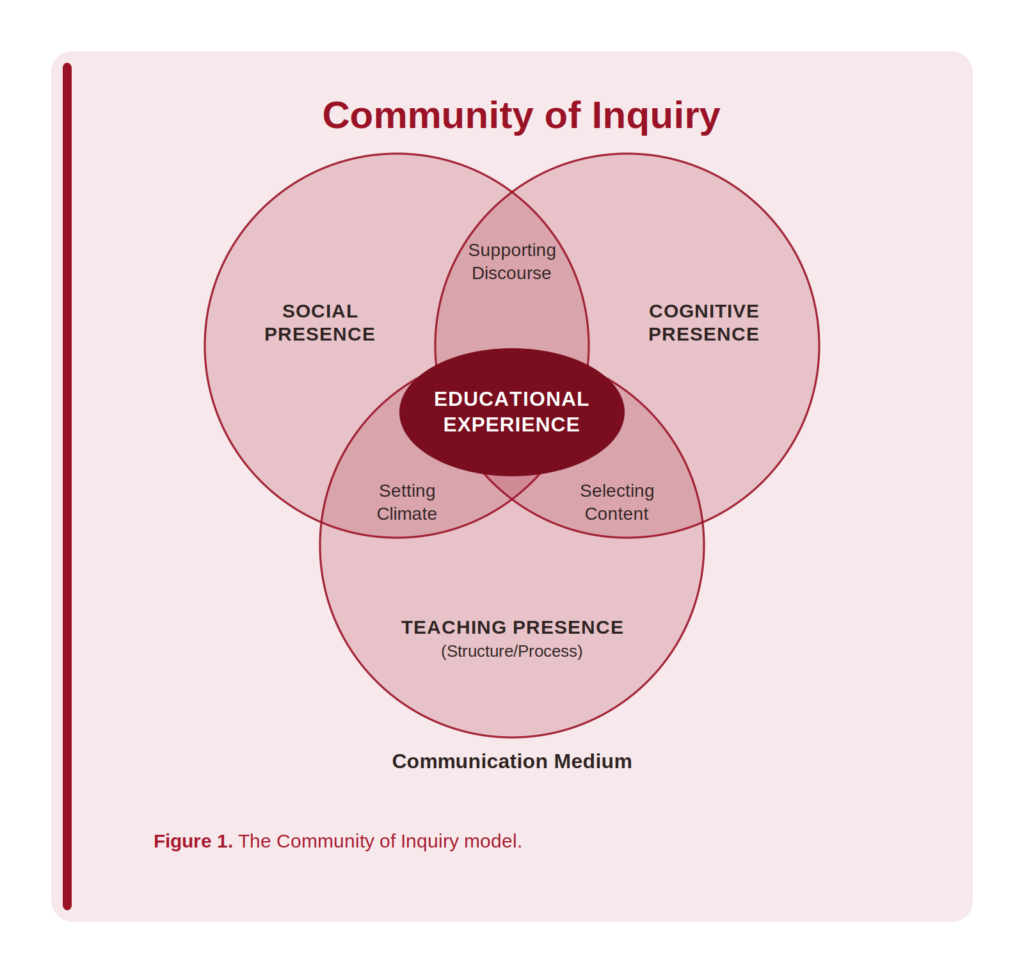
There is a lot of scholarship to explore in the CoI world, so we can only give an overview here. In this model, three elements sustain the learning experience: cognitive presence, teaching presence, and social presence (Shea, Richardson & Swan, 2022). Here we give a brief definition of each element and examples of how we saw them in action in our most recent course, Understanding and responding to hate speech.
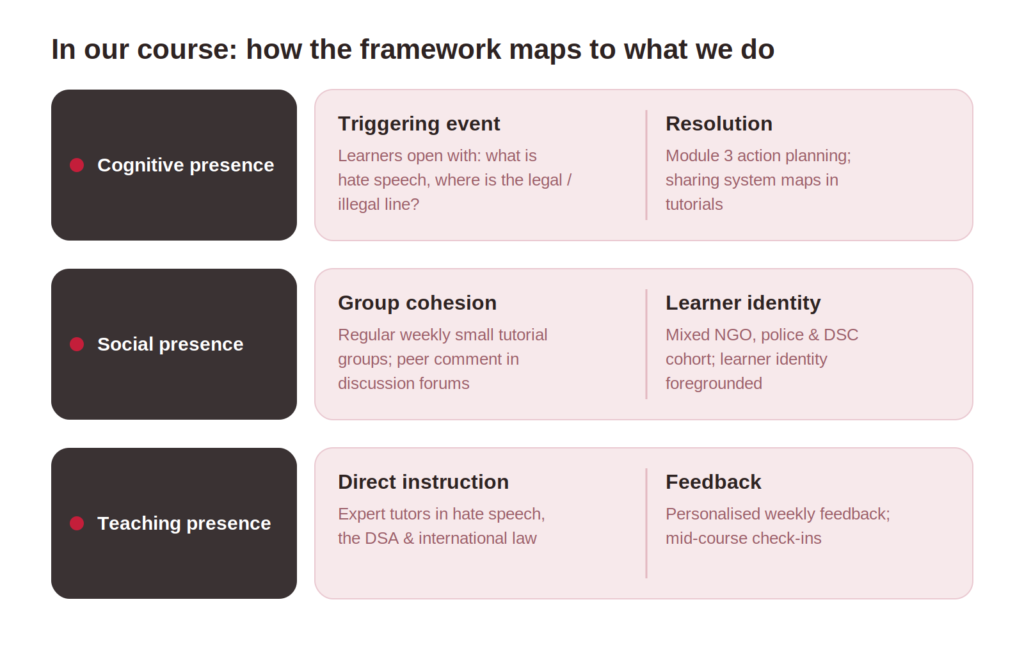
Cognitive presence is “the extent to which the participants in any particular configuration of a community of inquiry are able to construct meaning through sustained communication” (Garrison et al. 2000, p. 89). Cognitive presence runs throughout the course, mapped onto the four phases of the ‘practical inquiry model’: ‘triggering event’, ‘exploration’, ‘integration’, and ‘resolution’. As a result, participants should move “from understanding the nature of a problem to understanding what is relevant to the problem; specifically, participants make decisions about the integration of their suggested solutions.” (As Shea et al., 2022). In Understanding and responding to hate speech, the triggering event comes at the start, when learners confront fundamental questions: what actually is hate speech, what is its impact, and where does the line between legal and illegal expression fall? Learners then move into ‘exploration’, working through self-paced materials and mapping their own hate speech response system. ‘Integration’ happens as learners apply these new frameworks to situations from their own professional experience — revisiting a case they have handled, for example, and considering how they might approach it differently in light of what they have learned. ‘Resolution’ is approached when learners share their hate response system maps and priorities with peers in tutorials and country-focused discussion, with the aspiration that this leads to action beyond the course itself. Submitted assignments across all three modules are designed to function as triggering events in their own right, and tutorials serve as additional sites of exploration and collaborative learning.
Several quotes from our recent Understanding and Responding to Hate Speech course evidence cognitive presence in our learning design.
“It was incredibly helpful to have, in one place, an overview of all relevant legislation and international instruments. I found the sections of the course explaining the victim centred approach were brilliant, as well as the overview of categories of hate.”
“[as a result of taking part in this course] I have a strong understanding of international hate speech standards and legal frameworks, key tools to measure hate speech, response mechanisms, and key definitions.”
“I’m equipped with more clarity and confidence. It will be applied in conversational workshops and delivering messages when organizing events, counselling and work related to being Trusted Flagger under DSA.”
However, feedback also indicates the limitations of our context, in which longer, more intense courses are not possible for our community.
“I think the course could have benefitted from being extended by perhaps an additional week, with some content broken down into smaller segments. It was incredibly engaging and intellectually stimulating, but given the short duration, it was challenging to take everything in, especially in terms of the volume of information.”
The second element ‘social presence is, “the ability of participants in a community of inquiry to project themselves socially and emotionally, as ‘real’ people (i.e., their full personality), through the medium of communication being used” (Garrison et al. 2000, p. 94). Our learners come from a range of professional roles — police, civil society, public authorities — and those professional identities can be sources of tension as much as common ground. Our strategy is to foreground the learner identity that connects participants and to create the conditions in which people feel safe enough to engage confidently across professional and community boundaries.
Several quotes from our Understanding and Responding to Hate Speech course evidence social presence in our learning design.
“The atmosphere of the course has always been friendly and non-judgmental.”
“Yes, it was interesting to hear the perspectives of different professionals and how the situation is in different countries.”
“Yes, I had the opportunity to know how various organisations operate in the information space and issues presenting in their organisation. Great lessons were learnt that can be implemented in my organisation.”
However, there are indications that our learners need more time to fully benefit from social presence.
“It is very engaging and I hoped that there could have been more time for it.”
“Personally I would like the tutorial time to be stretched a bit longer for more interaction and learning.”
The third element, ‘teaching presence’, has two components: the design of the course materials, and the facilitation of the live learning experience itself (Garrison et al. 2000). The design, planned and led by instructional designers and e-learning developers, involves “the selection, organisation, and primary presentation of course content, as well as the design and development of learning activities and assessments” (Garrison et al. 2000, p. 89–90). Then, when the course commences, tutors actively moderate discussion forums, facilitate live tutorials and provide detailed feedback on weekly assignments. Of course, students themselves are active participants in making the learning environment come alive.
Other forms of teaching presence include email as well as notifications through our online learning platform at key stages in the course. Overlapping with cognitive presence, tutor input helps learners rethink their ideas, rephrase what they want to say, and redirect attention to different areas of the topic under discussion.
Several quotes from our Understanding and Responding to Hate Speech course evidence teaching presence in our learning design.
“The tutors are very encouraging and listen really well. The feedback is very detailed and encouraging.”
“[The tutors] did an absolutely amazing job engaging all the students, teaching key concepts, and ensuring we understood the materials. They were incredibly professional, academically strong, and genuinely kind throughout the course. A positive and supportive attitude.”
“They gave insights to the course materials and made the learning experience more in depth.”
“The tutorials created learning opportunities from each other and also the support from the team was always there and they were kind and responding.”
To further interrogate our approach, we drew on Fiock’s (2020) incredibly useful work to map our learning design against the three CoI presences. We present a detailed table of findings in Annex X, including further areas for improvement. The simpler overview below shows that overall, our learning design maps well against the CoI framework.
At the intersection of Facing Facts Online and the anti-hate community of practice
What is the relationship between our courses–or our periodic and intense communities of practice–and our broader anti-hate community of practice?
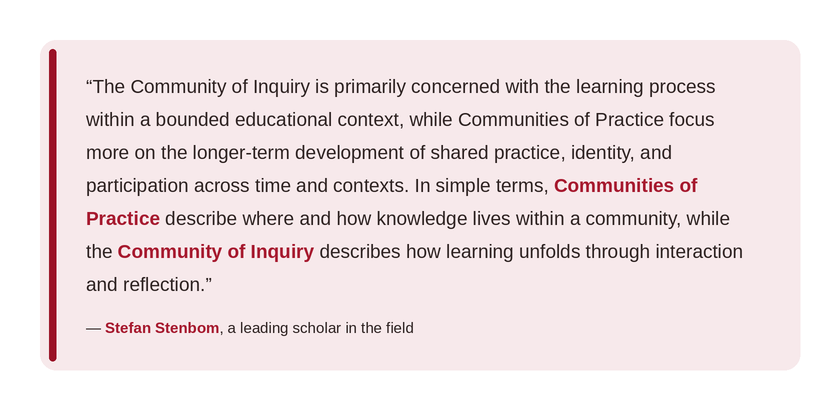
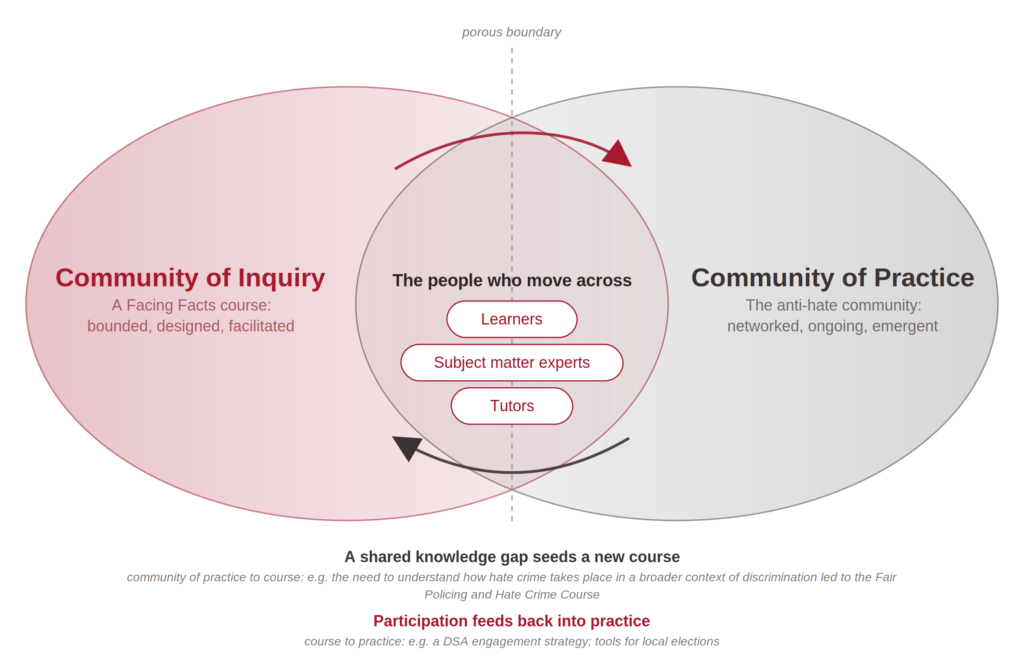
These distinctions between the CoI and CoP concepts helped us better approach the question of how and when a CoI might serve as a catalyst for — or be sustained by — a CoP, and vice versa. We can see this loop running in both directions in our own work. In one direction, a CoP can spark the need for a bounded CoI: when our Network identifies a shared knowledge gap or an emerging challenge, this can become the seed of a new course. In the other direction, a CoI can feed back into the CoP. For example, following participation in our Understanding and responding to hate speech course a public authority with obligations under the DSA approached us to support them with their new civil society organisation engagement strategy, drawing directly on the knowledge and skills they gained from the course. In another example, a public authority participant sought our support to develop original tools to counter hate speech in local elections. We are also experimenting with ways to strengthen the ‘pipeline’ from Facing Facts Network membership to course participation such as freely available micro-learning activities.
We wonder whether perhaps in our case the CoI-CoP ‘boundary’ is more porous because those who give life to the anti-hate community can be our learners, our subject matter experts and/or our tutors. Indeed, perhaps these individuals could be understood as bridges or portals between our bounded courses and the anti-hate community of practice. The role of these individuals in a professional learning community is probably underexplored since most CoI scholarship has taken place in university as opposed to professional community of practice settings.
The analytical gifts of the CoI and CoP concepts, the ‘porousness’ we have observed, and the encouraging examples of the direct impact of our courses in the broader community of practice have informed the design of our 2026 impact evaluation. We look forward to sharing the results and to continue our exploration of what works to support our community to strengthen hate response systems across Europe.
Find out more about the annex here.
Further References
Akcaoglu, M., & Lee, E. (2016). Increasing Social Presence in Online Learning through Small Group Discussions. The International Review of Research in Open and Distributed Learning, 17(3). https://doi.org/10.19173/irrodl.v17i3.2293
Cleveland-Innes, M. F., Stenbom, S., & Garrison, D. R. (Eds.). (2024). The Design of Digital Learning Environments: Online and Blended Applications of the Community of Inquiry. Routledge. https://doi.org/10.4324/9781003246206
Fiock, H. (2020). Designing a Community of Inquiry in Online Courses. The International Review of Research in Open and Distributed Learning, 21(1), 135–153. https://doi.org/10.19173/irrodl.v20i5.3985
Garrison, D. R., Anderson, T., & Archer, W. (2001). Critical thinking, cognitive presence, and computer conferencing in distance education. American Journal of Distance Education, 15(1), 7–23. https://doi.org/10.1080/08923640109527071
Lave, J., & Wenger, E. (1991). Situated learning: Legitimate peripheral participation. Cambridge University Press.
Martin, F., Wu, T., Wan, L., & Xie, K. (2022). A meta-analysis on the community of inquiry presences and learning outcomes in online and blended learning environments. Online Learning, 26(1), 325–359. https://doi.org/10.24059/olj.v26i1.2604
Parrish, C. W., Guffey, S. K., Williams, D. S., Estis, J. M., & Lewis, D. (2021). Fostering cognitive presence, social presence and teaching presence with integrated online-team-based learning. TechTrends, 65(4), 473–484. https://doi.org/10.1007/s11528-021-00598-5
Kessaris, A. P.-, & Perry, J. (2020). Enhancing Participatory Strategies With Designerly Ways for Sociolegal Impact: Lessons From Research Aimed at Making Hate Crime Visible. Social & Legal Studies, 29(6), 835-857.
Richardson, J. C., Maeda, Y., Lv, J., & Caskurlu, S. (2017). Social presence in relation to students’ satisfaction and learning in the online environment: A meta-analysis. Computers in Human Behavior, 71, 402–417. https://doi.org/10.1016/j.chb.2017.02.001
Richardson, J., Fiock, H., Olesova, L., & Stenbom, S. (2024). Evidence-based Practices for Developing a Community of Inquiry. In Martindale, T., Amankwatia, T.B., Cifuentes, L.D., & Pĩa, A.A. (Eds.) Handbook of Research in Online Learning. Brill. https://doi.org/10.1163/9789004702813_012
Shea, P., Richardson, J., & Swan, K. (2022). Building bridges to advance the community of inquiry framework for online learning. Educational Psychologist, 57(3), 148–161. https://doi.org/10.1080/00461520.2022.2089989
Wenger, E. (1998). Communities of practice: Learning, meaning, and identity. Cambridge University Press.
Wenger, E., McDermott, R., & Snyder, W. M. (2002). Cultivating communities of practice: A guide to managing knowledge. Harvard Business School Press.

Leave a Reply