
From Our Members to the EU: How the Facing Facts Network provided inputs to the Draft Trusted Flagger Guidelines
On 29 May 2026, the European Commission launched a targeted consultation on its draft Guidelines on the trusted flagger mechanism under Article 22 of the Digital Services Act (DSA). The Commission invited stakeholders with relevant expertise, including civil society organisations, to share views, good practices and evidence. As the Facing Facts Network Secretariat, we facilitated an exchange among our members to contribute to the consultation. Since 2014, our work on online hate speech has grown into a multistakeholder Europe-wide network of practitioners, shaped by our online learning platform Facing Facts Online and continued engagement with our members’ experience and expertise.
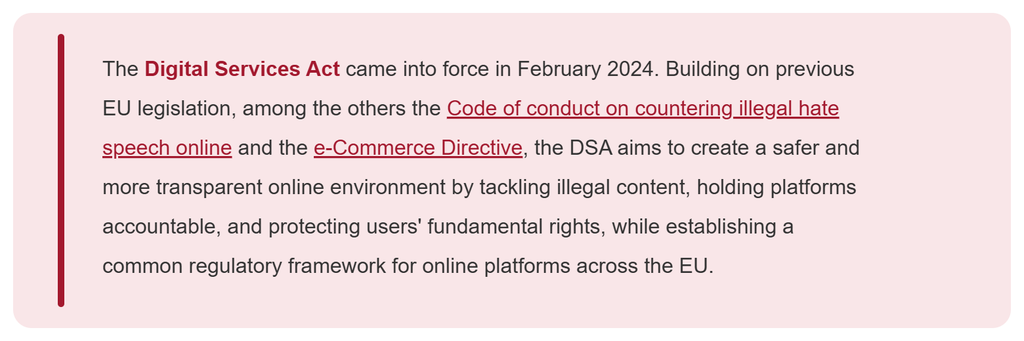
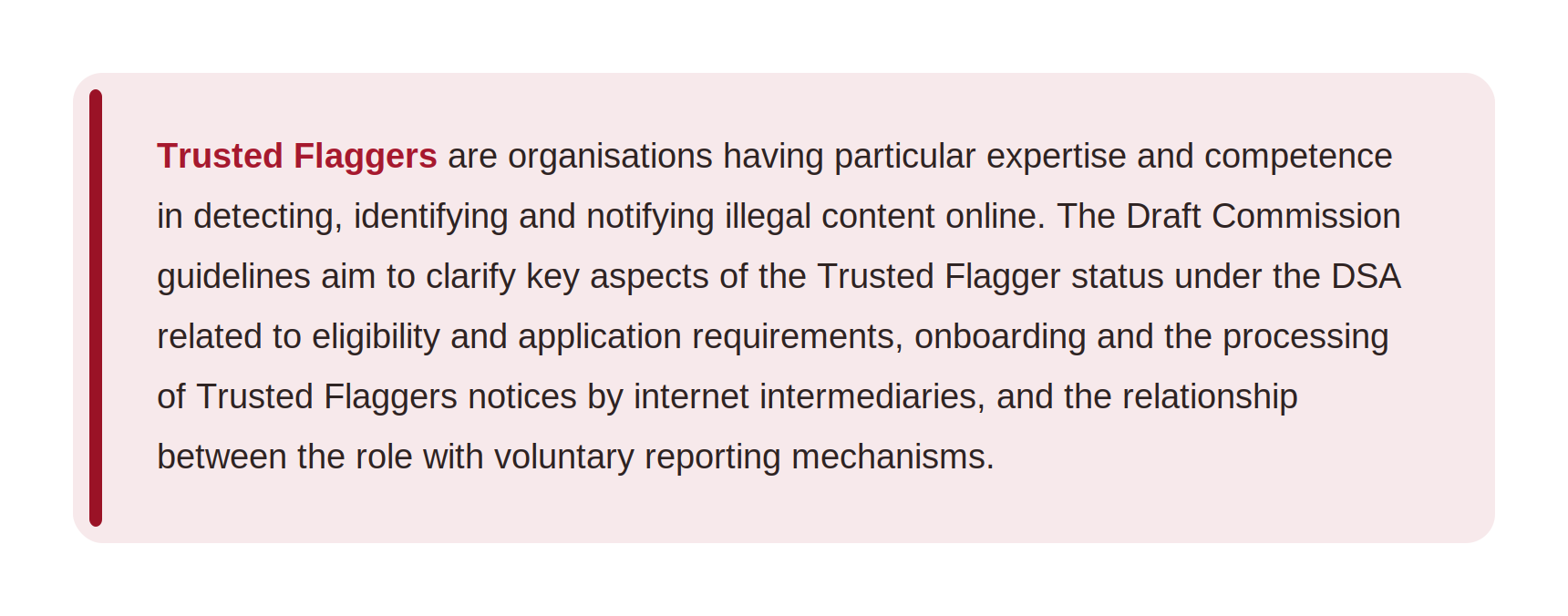
The DSA and Trusted Flaggers
Our policy reflections on the DSA’s implementation
In 2024, we published a policy brief on What is the Digital Services Act & what does it mean for hate speech monitoring & responses? to clarify the Digital Services Act’s national implementation, mapping the actors, their roles and responsibilities, the new enforcement ecosystem, and centering the communities experiences and victims approach for EU institutions. The recommendations from the policy brief stressed the importance for Facing Facts to work with its members and partners to monitor the implementation of the Digital Services Act at the national level and bring forward key themes and gaps to the attention of partners at the EU level.
Since 2025, our online course on Understanding and Responding to Hate Speech, which includes a dedicated section on the DSA, has brought together actors from across the hate speech response system. This has given us further opportunities to reflect, alongside the wider hate speech community, on how the DSA’s framework of cooperation works in practice.
With this in mind, between June and July 2026, we coordinated our members’ contribution to the European Commission’s public consultation.
What our members told us
This consultation came at a critical time for those who have dedicated time and resources to monitoring and reporting hate online. Platforms are rolling back protections, algorithms amplify division, and some civil society organisations are stepping aside from monitoring hate speech to protect their staff’s well-being. Our members’ input shows that some challenges that we highlighted in our 2024 DSA Policy Brief remain unresolved.
Functioning of the DSA Response System: The draft Guidelines fail to recognise the vital role played by TFs in protecting core democratic values. There is also lack of guidance on the relationship between law enforcement and TFs related to evidence preservation, due to the clause of ‘removal “without undue delay”’ that can destroy evidence and undermine police investigations, together with the question of who has authority to determine content illegality.
Platform unaccountability: The guidelines set out in detail how TFs are to be regulated, while imposing generic, unenforceable expectations on platforms. There is no requirement for proof of platform decision-makers’ expertise, no duty to give reasons for dismissing notices, no sanctions or TF recourse for inadequate platform channels, and no monitoring of platform misconduct towards TFs. All of this supports the power imbalance between TF and internet intermediaries.
Vulnerability of the Trusted Flagger role: Network members pointed out how the role is voluntary, unpaid and self-resourced together with attracting reputational and other risks both for the organisation and the staff. A related concern is the lack of clarity on independence in connection with the potential funding of TF activities by platforms. Members proposed a Commission-run fund, financed by internet intermediaries, but managed independently of them, to support Trusted Flagger activities.
How we built our response together
For many of our members, particularly smaller organisations and public authorities, engaging with a 40-page policy document alongside their day-to-day work can be challenging.
We began by reviewing the draft guidelines and identifying initial questions and areas for consideration, drawing on our experience of the different iterations of monitoring exercises carried out between 2016 and 2022 under the Code of Conduct, as well as subsequent continuous monitoring initiatives such as the EU-Funded project SafeNet, coordinated by INACH. This provided a starting point for bringing our members’ practical experiences into the wider European policy discussion.
Rather than asking every member to draft a full consultation response, we created a process that allowed them to share their experiences, identify challenges and build on each other’s ideas. After an initial assessment, we brought members together with online meetings and a shared document. During the Facing Facts Annual Network Meeting (29 – 30 June), we had the opportunity to be hosted by the Austrian Digital Services Coordinator, RTR KommAustria. The session was a valuable chance not only to connect with DSA actors and the EU Fundamental Rights Agency, but also to unpack shared challenges and listen to the perspectives of the diverse actors in the room, Trusted Flaggers, civil society organisations, monitoring reporters, police, equality bodies, ministries and public authorities.
Taking our input to the DSA civil society roundtable
On 23 September 2026, Facing Facts team joined the European Commission’s fifth DSA civil society roundtable on systemic risks. It was the opportunity to reiterate our members’ call for civil society expertise to be treated as operational expertise, for risk assessments that examine how platform design and algorithmic amplification increase exposure to illegal content, and for data to be included in the internet intermediaries transparency reports on platforms decisions on notices from users and Trusted Flaggers reported content.
The value of making different perspectives visible
Our members work across different countries, languages and forms of hate. That diversity helps us see issues that might otherwise remain invisible – from differences in how platforms understand hate speech across languages to the different experiences of organisations working on victim support, monitoring activities, strategic litigation and research in support of diverse communities across Europe.
Ultimately, the experience reinforced something we already know but continue to appreciate: the real strength of Facing Facts is not simply the expertise within the Network, but our ability to make perspectives across the hate response system visible.
Civil society organisations, Trusted Flaggers, monitoring reporters, police forces, public authorities, equality bodies and Digital Services Coordinators do not always have natural opportunities to exchange with one another. Creating those spaces for dialogue is one of the things that makes Facing Facts distinctive.
Our submission to the Trusted Flagger consultation was an example of how European cooperation can work in practice: connecting national experiences, sharing expertise and creating opportunities for those working on the ground to inform European policymaking. As the challenges around online hate speech and the Digital Services Act continue to evolve, we hope to build on this approach – strengthening the bridges between European and national levels and bringing diverse experiences to the heart of the conversation.
If you would like to join the conversation and understand how the Digital Services Act impacts your organisations or you would like to understand the work around hate speech, join the Facing Facts community by participating in the online course on Understanding and Responding to Hate Speech.
Our submission reflects direct contributions and feedback from 11 Facing Facts Network member organisations and builds on the collective expertise of the Facing Facts Network, which brings together 42 member organisations across 20 EU countries. The following contributing organisations have consented to be mentioned: DigiQ (Slovakia), Fondazione Centro di Documentazione Ebraica Contemporanea (CDEC) Observatory on Antisemitism (Italy), Fundación Secretariado Gitano (Spain), Háttér Society (Hungary), Human Rights House Zagreb (Croatia), INACH (The Netherlands), Jewish Association Czulent (Poland), LICRA (France), National Institute for the Study of the Holocaust in Romania (INSHR) “Elie Wiesel” (Romania), and ZARA – Civil Courage and Anti-Racism Work (Austria).
Access the input shared by the Facing Facts Network
To view the full document, please provide your details below.
Leave a Reply